







What used to be common practice still holds true today: a few years ago, proving you were human meant clicking on traffic lights, deciphering warped letters, or spotting objects in a grid. That had two effects: you proved your "humanity", and at the same time you actively helped improve the underlying machine learning algorithms.
Today you might click fewer CAPTCHA grids, but you are working for others more than ever. Your images, texts, code snippets, and corrections form a solid training base for AI models like ChatGPT, Gemini, DeepSeek, and the rest.
Long story short: Whenever you use AI, you help train it. Your prompts, images, texts, or code all flow back into the machine to make today's LLMs (Large Language Models) better.
Honestly, you deserve an achievement for that. 👍
Why are so many AI tools free?
Simple: because your content is the product. For companies, collecting user data, including your prompts, images, texts, and corrections, is far cheaper than buying licenses for existing datasets.
Every generated image, every polished sentence, and every creative prompt helps train the model for free, and in many cases you even pay for the privilege of training those AI models.
Why is your content used for training?
In the beginning, companies like Google (Gemini) and OpenAI (ChatGPT, DALL·E) crawled the web, including forums, social media, and blogs. Over time, their need for usable content kept growing so they could hold their ground in the market. That is why user numbers are so decisive for these tools: the more users they have, the more voluntary helpers they have supporting them in training their LLMs, because that is cheaper, more efficient, and usually legal.
Can you prevent AI from being fed with your content?
Realistically, no. Even if you do not use AI yourself, someone else can share your content. Maybe your work is already spread across social media or the web, like it is for most of us. If you live digitally, you become part of the training data; there is no real way around it.
Does AI make life easier?
The dream: less stress, more time for what matters and for life itself. And yes, sometimes that works.
Still, if history and the Industrial Revolution teach us one thing, it is this: higher productivity does not automatically mean more freedom or a happier, more meaningful life.
Think back to 1490: a courier carried letters from town to town. He still felt a connection to his work and the sense of moving something that mattered, because his work helped connect people's lives. While carrying the mail from town to town, he could take in the landscape and let his thoughts flow. Today we have machines, the internet, and automation, yet do we actually feel freer or more connected? Or just overwhelmed, stressed, and drained of meaning by repetitive, ever more "efficient" tasks?
The more efficient we become, the more we pile onto ourselves. That is the burnout trap. Maybe the time has come to rethink our fixation on output and ask how AI can help us as a society gain real quality of life, not just "faster, cheaper, more".
Does AI hold copyright?
Technically, no. Right now, only humans can be authors under copyright law. Even so, the boundaries are blurring.
Open questions remain:
- Who owns the output?
- Who gets credit, or blame?
- What happens when "new" output is built on your work?
This topic will stay with us for a long time.
Do we need new laws for AI?
AI cannot be stopped anymore, much like the internet in the 1990s. Even with regulation and new laws, the impact is already here, and LLMs are accessible to everyone.
No country that wants to keep up globally will ban AI outright. Even where protection would make sense, competition usually wins, and nobody wants "the bad guys" to reach the finish line first. It is a psychological trap we see again and again in modern politics: we judge the other side, and to protect ourselves we follow their example (telling ourselves we are forced to), even when we end up doing the exact same thing as the people we feared.
Where are the limits of AI?
Simple: LLMs (Large Language Models) do not invent anything on their own and cannot be genuinely creative without human input. If a model has never seen a lemon cake recipe, it cannot generate one or put it into context. It simply does not know what a lemon cake is.
Today that is rarely obvious because the training datasets are massive. Still, the rule holds: what was never learned cannot be generated.
What looks clever is often just very good remixing.
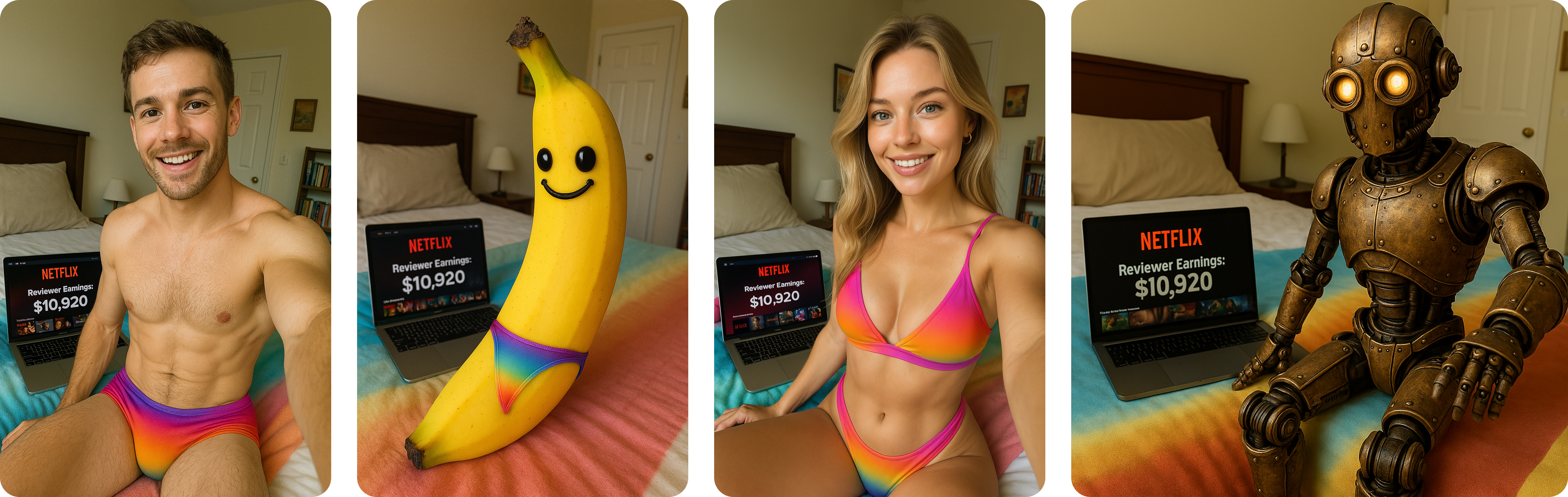
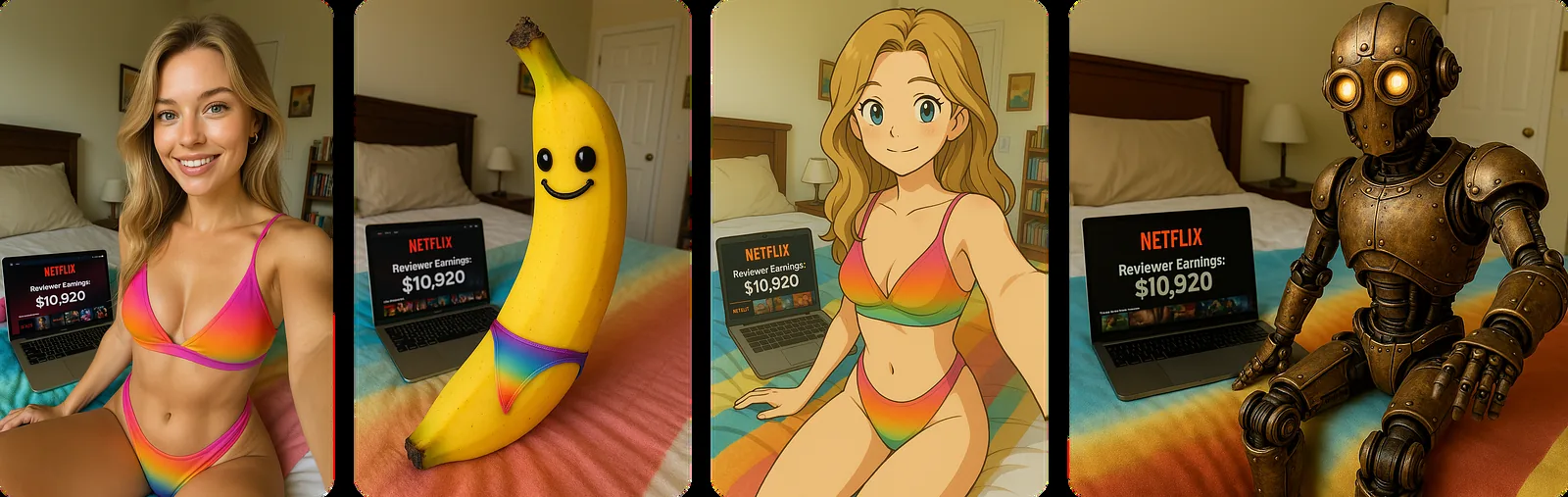 Generated with ChatGPT-4o. The end of stock photos. A steampunk robot relaxing naturally on a bed is apparently still too much to ask.
For example: a POV shot of a beautiful woman on a bed? Easy. A steampunk robot sitting relaxed on a bed? Difficult, because there is simply too little reference material on the web.
Can AI be creative?
Yes and no. When you let AI do the work, you are using, consciously or unconsciously, the work of other people. Take the Studio Ghibli trend: AI generates images in that unmistakable style, built directly on Miyazaki's aesthetic.
Miyazaki himself said of AI animation:
"I strongly feel that this is an insult to life itself."
Life is also interpretation. We all learn by observing others, imitating, and recombining. AI does the same thing: it learns from what it has seen and produces something that looks like its own, so anyone can feel a little bit creative.
AI and social engineering
By nature, LLMs give answers that sound right without having to be right. That is what makes them dangerous: they easily convince you that something is accurate, sensible, or original when it is not.
When you are stressed, tired, or unfocused, it is easy to fall for that confidence and just let the AI take over. AI can quickly lead you astray and even leave psychological marks: you end up feeling tired, unhappy, or burned out. Those are just a few of the psychological consequences I see emerging (I may write a separate piece exploring my thoughts and hypotheses on that).
How much energy does generative AI consume?
Yesterday's big energy topic was Bitcoin. Today it is AI. Training GPT-3 consumed around 1.3 GWh of energy, enough to power an average US home for over 120 years. And that was in 2020.
Today we have:
- GPT-4 (~1.8 trillion parameters, Mixture-of-Experts)
- Gemini 2.5 (likely on a similar scale)
- Claude 3
- DeepSeek
- LLaMA 2, and LLaMA 3
I built a €6,000 workstation myself to experiment with local LLMs, and compared to server farms with thousands of Nvidia GPUs (or Apple, ARM, and Qualcomm silicon), it is a toy at best. It is staggering how many resources are spun up for everyone using AI today.
The fact is: nobody is hitting the brakes. AI infrastructure is growing fast. Here we can only hope for breakthroughs in chip manufacturing, more efficient algorithms, or energy generation, because the appetite for more AI compute shows no sign of slowing down.
AI is here to stay
AI is not going away: your everyday digital life already feeds it. Even if you do not use it actively, your content sooner or later ends up in the training material anyway. The only way out would be to turn your back on digital life completely, and even then someone else might upload your work as a reference or inspiration onto a server somewhere.
Use AI to spend less time on mindless tasks so you can direct your energy toward what truly matters to you. Do not let AI take over the work for you; treat it as support or an accelerator to take your craft to the next level. When you write, write yourself, and use AI only for the final polish: corrections, structure, flow. Do not use it to have whole articles written for you, because the result would not be you, just a distorted image of yourself. In the long run, that can take a real toll on your mental health.
If you feel no genuine connection to writing, coding, drawing, or another creative field, do not force yourself into it. Otherwise you risk sacrificing yourself over time by producing more and more content that has nothing to do with you or your interests. When an AI does most of the work for you, it is ultimately no different from copying other people's work and publishing it under your own name. Honestly, would you do that with full conviction?
Let AI help you skip the boring part so you can focus on what you actually want to do: write, design, build, and create.
👋 Personal note
I am dyslexic, and I love writing. Still, the fear of publishing often holds me back. Especially when I am tired or my head is full, the fear of mistakes grows louder.
The result: stacks of notebooks and plenty of thoughts, yet very little of it makes its way out into the world. Today I use AI as a co-pilot, together with my wife (❤️), who proofreads every word. That lets me share more without fearing the grammar police.
